Dog Stone Age Art Dog Stone Age Art Ina Cave

The Paleolithic canis familiaris was a Belatedly Pleistocene canine. They were direct associated with homo hunting camps in Europe over 30,000 years agone and it is proposed that these were domesticated. They are further proposed to be either a proto-dog and the ancestor of the domestic domestic dog or an extinct, morphologically and genetically divergent wolf population.
Taxonomy [edit]
One dominance has classified the Paleolithic domestic dog as Canis c.f. familiaris [1] (where c.f. is a Latin term pregnant uncertain, as in Canis believed to exist familiaris). Previously in 1969, a written report of ancient mammoth-os dwellings at the Mezine paleolithic site in the Chernigov region, Ukraine uncovered 3 possibly domesticated "short-faced wolves".[2] [iii] The specimens were classified as Canis lupus domesticus (domesticated wolf).[iii] [4]
Naming [edit]
In 2002, a study looked at 2 fossil skulls of large canids dated at 16,945 years before present (YBP) that had been found buried 2 metres and vii metres from what was in one case a mammoth-bone hut at the Upper Paleolithic site of Eliseevichi-i in the Bryansk region of central Russia, and using an accepted morphologically based definition of domestication declared them to be "Ice Age dogs".[5] In 2009, some other study looked at these ii early on dog skulls in comparing to other much earlier but morphologically similar fossil skulls that had been found beyond Europe and concluded that the earlier specimens were "Paleolithic dogs", which were morphologically and genetically distinct from Pleistocene wolves that lived in Europe at that fourth dimension.[6]
Description [edit]
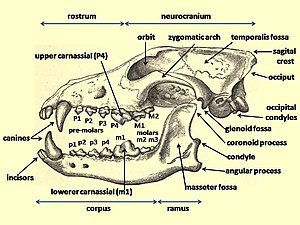
Diagram of a wolf skull with key features labelled
The Paleolithic dog was smaller than the Pleistocene wolf (Canis c.f. lupus) [i] and the extant greyness wolf (Canis lupus), with a skull size that indicates a dog like in size to the mod large domestic dog breeds. The Paleolithic dog had a mean trunk mass of 36–37 kg (79–82 lb) compared to Pleistocene wolf 42–44 kg (93–97 lb) and contempo European wolf 41–42 kg (90–93 lb).[half-dozen]
The earliest sign of domestication in dogs was thought to be the neotenization of skull morphology[7] [8] [9] and the shortening of snout length. This leads to tooth crowding, a reduction in tooth size and the number of teeth,[seven] [10] which has been attributed to the strong selection for reduced aggression.[7] [viii]
Compared with the Pleistocene and modern wolves, the Paleolithic dog had a shorter skull length, a shorter viscerocranium (face) length, and a wider snout.[6] It had a wider palate and wider braincase,[vi] [9] relatively short and massive jaws, and a shorter carnassial length just these were larger than the modern dog and closer to those of the wolf. The mandible of the Paleolithic dog was more massive compared to the elongated mandible of the wolves and had more crowded premolars, and a hook-like extension in the caudal border of the coronoid process of the mandible. The snout width was greater than those of both the Pleistocene and modern wolves, and implies well-developed carnassials driven by powerful jaws. In two morphometric analyses, the nearest dog skull-shape that was similar to the Paleolithic canis familiaris was that of the Central Asian Shepherd Dog.[6]
Diet [edit]
In 2015, a study of bone collagen taken from a number of species plant at the thirty,000 YBP mammoth-hut site of Predmosti in the Czech republic indicted that the Pleistocene wolf ate equus caballus and perhaps mammoth, the Paleolithic dog ate reindeer and muskox, and the humans ate specifically mammoth. The study proposes that the Paleolithic domestic dog's nutrition had been artificially restricted because it was not a diet similar to the Pleistocene wolf. Some remote Arctic tribal people today restrict the diet of their dogs abroad from what those people prefer to eat.[ane] An analysis of a specimen from the Eliseevichi-1 site on the Russian plain too revealed that the Paleolithic dog ate reindeer.[eleven]
In 2020, a study of dental microwear on molar enamel for canine specimens from Predmosti dated 28,500 YBP advise a higher bone consumption for the proto-dogs compared with wolf specimens. This indicates two morphologically and behaviourally different canine types. The study proposes that the proto-dogs consumed more bone along with other less desirable food scraps within homo camps, therefore this may be evidence of early on canis familiaris domestication.[12]
Archaeological evidence [edit]
- Run across farther Paleoecology of the fourth dimension
Early on specimens [edit]
At that place are a number of recently discovered specimens which are proposed equally being Paleolithic dogs, still their taxonomy is debated. These have been found in either Europe or Siberia and date 40,000–17,000 YBP. They include Hohle Fels in Deutschland, Goyet Caves in Belgium, Predmosti in the Czech Commonwealth, and iv sites in Russia: Razboinichya Cave in the Altai Democracy, Kostyonki-8, Ulakhan Sular in the Sakha Commonwealth, and Eliseevichi one on the Russian manifestly. Paw-prints from Chauvet Cave in France dated 26,000 YBP are suggested equally beingness those of a dog, yet these take been challenged as beingness left by a wolf.[13]
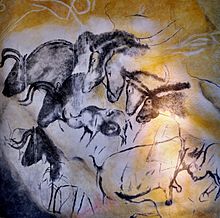
Chauvet cavern artistic delineation of horses dated thirty,000 years agone
| Years BP | Location | Finding |
|---|---|---|
| xl,000–35,000 | Hohle Fels, Schelklingen, Germany | Paleolithic dog |
| 36,500 | Goyet Caves, Mozet, Belgium | Paleolithic dog |
| 33,500 | Razboinichya Cavern, Altai Mountains, Central Asia | Paleolithic domestic dog |
| 33,500–26,500 | Kostyonki-Borshchyovo archaeological circuitous, Voronezh, Russian federation | Paleolithic dog |
| 31,000 | Predmostí, Moravia, Czech Republic | Paleolithic canis familiaris |
| 26,000 | Chauvet Cave, Vallon-Pont-d'Arc, French republic | Paw-prints |
| 17,200 | Ulakhan Sular, northern Yakutia, Siberia | Paleolithic domestic dog |
| 17,000–16,000 | Eliseevichi-I site, Bryansk Region, Russian Plain, Russia | Paleolithic dog |
There are also a number of afterwards proposed Paleolithic dogs whose taxonomy has not been confirmed. These include a number of specimens from Federal republic of germany (Kniegrotte, Oelknitz, Teufelsbrucke), Switzerland (Monruz, Kesslerloch, Champre-veyres-Hauterive), and Ukraine (Mezin, Mezhirich). A set of specimens dating 15,000–xiii,500 YBP have been confidently identified equally domesticated dogs, based on their morphology and the archaeological sites in which they have been constitute. These include Spain (Erralla), France (Montespan, Le Morin, Le Closeau, Pont d'Ambon), and Germany (Bonn-Oberkassel). After this menstruation, the remains of domesticated dogs have been identified from archaeological sites beyond Eurasia.[13]
Possible domestic dog domestication between 15,000 and 40,000 YBP is not articulate due to the debate over what the Paleolithic dog specimens represent. This is due to the flexibility of genus Canis morphology, and the shut morphological similarities between Canis lupus and Canis familiaris. It is also due to the scarcity of Pleistocene wolf specimens available for analyses and so their morphological variation is unknown. Habitat type, climate, and casualty specialization greatly modify the morphological plasticity of greyness wolf populations, resulting in a range of morphologically, genetically, and ecologically singled-out wolf morphotypes. With no baseline to work from, zooarchaeologists find it difficult to be able to differentiate between the initial indicators of dog domestication and various types of Late Pleistocene wolf ecomorphs, which can lead to the mis-identification of both early on dogs and wolves. Additionally, the ongoing prehistoric admixture with local wolf populations during the domestication procedure may take led to canids that were domesticated in their behavior merely wolflike in their morphology. Attempting to identify early tamed wolves, wolfdogs, or proto-dogs through morphological analysis alone may be impossible without the inclusion of genetic analyses.[13]
All specimens [edit]
The table beneath lists by location and timing in years before present the very early on co-location of hominid and wolf specimens, followed past proposed paleolithic domestic dog and then early dog specimens, with the regions in which they had been found color-coded as purple – Western Eurasia, red – Eastern Eurasia and light-green – Primal Eurasia.
| Years BP | Location | Finding |
|---|---|---|
| 400,000 | Boxgrove near Kent, England | Wolf bones in shut clan with hominid bones. These have been found in Lower Paleolithic sites including Boxgrove (400,000 YBP), Zhoukoudian in North Communist china (300,000 YBP), and Grotte du Lazaret (125,000 YBP) in southern French republic. "The sites of occupation and hunting activities of humans and wolves must frequently take overlapped."[xiv] We do not know if the co-location was the effect of coincidence or a relationship. |
| 300,000 | Zhoukoudian cave arrangement, China | Pocket-size, extinct wolf skulls of Canis variabilis. At the site, the small wolf's remains were in shut proximity to Peking homo (Homo erectus pekinensis).[xv] We exercise not know if the co-location was the effect of coincidence or a human relationship. |
| 125,000 | Grotte du Lazaret, well-nigh Squeamish, France | Wolf skulls appear to have been fix at the archway of each dwelling in a complex of Paleolithic shelters. The excavators speculated that wolves were already incorporated into some aspect of homo culture past this early time. A nearby wolf den intruded on the site.[16] In 1997, a report of maternal mDNA indicated that the genetic divergence of dogs from wolves occurred 100,000–135,000 YBP.[17] The Lazaret digging lends credence to this mDNA report, in addition to indicating that a special relationship existed betwixt wolves and genus Human being other than Homo sapiens, because this engagement is well earlier the arrival of Homo sapiens into Europe.[18] In 2018, a study of paternal yDNA indicated that the dog and the modern greyness wolf genetically diverged from a mutual antecedent between 68,000 and 151,000 YBP.[nineteen] |
| twoscore,000–35,500 | Hohle Fels, Schelklingen, Germany | Canid maxillary fragment. The size of the molars matches those of a wolf, the morphology matches a dog.[xx] Proposed as a Paleolithic dog. The figurine Venus of Hohle Fels was discovered in this cave and dated to this time. |
| 36,500 | Goyet Cave, Samson River Valley, Belgium | The "Goyet canis familiaris" is proposed equally beingness a Paleolithic dog.[six] The Goyet skull is very similar in shape to that of the Eliseevichi-I dog skulls (16,900 YBP) and to the Epigravettian Mezin 5490 and Mezhirich domestic dog skulls (13,500 BP), which are about 18,000 years younger.[six] [21] The dog-like skull was establish in a side gallery of the cavern, and Palaeolithic artifacts in this system of caves appointment from the Mousterian, Aurignacian, Gravettian, and Magdalenian, which indicates recurrent occupations of the cavern from the Pleniglacial until the Late Glacial.[6] The Goyet dog left no descendants, and its genetic classification is inconclusive because its mitochondrial DNA (mDNA) does non match any living wolf nor domestic dog. It may represent an aborted domestication effect or phenotypically and genetically distinct wolves.[22] A genome-broad study of a 35,000 YBP Pleistocene wolf fossil from northern Siberia indicates that the domestic dog and the mod gray wolf genetically diverged from a mutual antecedent between 27,000 and forty,000 YBP.[23] [xviii] |
| 33,500 | Razboinichya Cave, Altai Mountains, Central Asia (Russian federation) | The "Altai dog" is proposed as being a Paleolithic dog.[half-dozen] The specimens discovered were a dog-like skull, mandibles (both sides) and teeth. The morphological classification, and an initial mDNA analysis, constitute information technology to be a dog.[24] A later report of its mDNA was inconclusive, with two analyses indicating domestic dog and another 2 indicating wolf. In 2017, two prominent evolutionary biologists reviewed the evidence and supported the Altai dog as being a canis familiaris from a lineage that is at present extinct and that was derived from a population of pocket-sized wolves that are also now extinct.[25] |
| 33,500–26,500 | Kostyonki-Borshchyovo archaeological complex, Voronezh, Russia | One left mandible paired with the right maxilla, proposed equally a Paleolithic dog.[26] |
| 31,000 | Predmostí, Moravia, Czech Commonwealth | Three canis familiaris-like skulls proposed as being Paleolithic dogs.[26] Predmostí is a Gravettian site. The skulls were found in the human being burying zone and identified as Palaeolithic dogs, characterized past – compared to wolves – brusk skulls, brusk snouts, wide palates and braincases, and even-sized carnassials. Wolf skulls were also found at the site. I dog had been buried with a bone placed advisedly in its oral fissure. The presence of dogs cached with humans at this Gravettian site corroborates the hypothesis that domestication began long before the Late Glacial.[27] [28] Further analysis of bone collagen and dental microwear on molar enamel indicates that these canines had a different diet when compared with wolves (refer under diet).[eleven] [12] |
| 30,800 | Badyarikha River, northern Yakutia, Siberia | Fossil canid skull. The specimen could not exist classified as wolf nor Paleolithic canis familiaris.[29] |
| 26,000 | Chauvet Cave, Vallon-Pont-d'Arc, Ardèche region, France | fifty-metre trail of footprints fabricated past a boy of about 10 years of age alongside those of a large canid. The size and position of the canid's shortened eye toe in relation to its pads indicates a dog rather than a wolf. The footprints take been dated by soot deposited from the torch the child was carrying. The cavern is famous for its cave paintings.[30] A later study using geometric morphometric analysis to compare modern wolf with mod canis familiaris tracks proposes that these are wolf tracks.[31] |
| eighteen,000 | Indigirka, Yakutia, Siberia | Dogor, a canine pup preserved in permafrost and yet to be identified as being a dog or wolf.[32] |
| 17,300–14,100 | Dyuktai Cave, northern Yakutia, Siberia | Large canid remains along with human artefacts.[29] |
| 17,200–sixteen,800 | Ulakhan Sular, northern Yakutia, Siberia | Fossil dog-like skull similar in size to the "Altai dog", proposed every bit a Paleolithic dog.[29] |
| 17,000–16,000 | Eliseevichi-I site, Bryansk Region, Russian Plain, Russia | 2 fossil canine skulls proposed every bit being a Paleolithic dogs.[6] In 2002, a study looked at the fossil skulls of two large canids that had been found buried 2 metres and 7 metres from what was once a mammoth-bone hut at this Upper Paleolithic site, and using an accepted morphologically based definition of domestication declared them to be "Ice Historic period dogs". The carbon dating gave a calendar-year age estimate that ranged between 16,945 and 13,905 YBP.[5] The Eliseevichi-1 skull is very similar in shape to the Goyet skull (36,000 BP), the Mezine dog skull (thirteen,500 BP) and Mezhirich dog skull (13,500 BP).[6] In 2013, a study looked at the mDNA sequence for 1 of these skulls and identified it as Canis lupus familiaris i.eastward. dog.[22] However, in 2015 a report using iii-dimensional geometric morphometric analyses indicated the skull is more probable from a wolf.[33] [34] These animals were larger in size than nigh grey wolves and approach the size of a Keen Dane.[35] |
| 16,900 | Afontova Gora-i, Yenisei River, southern Siberia | Fossil canis familiaris-like tibia, proposed equally a Paleolithic dog. The site is on the western bank of the Yenisei River most ii,500 km southwest of Ulakhan Sular, and shares a similar timeframe to that canid. A skull from this site described as dog-like has been lost in the past, merely there exists a written description of it possessing a wide snout and a articulate stop, with a skull length of 23 cm that falls outside of those of wolves.[29] |
| 16,700 | Kniegortte, Germany | Fractional maxillary fragment with teeth dated 16,700–13,800 YBP.[36] Taxonomy uncertain.[xiii] |
| 16,300 | Monruz, Switzerland | Deciduous teeth possibly from a dog.[37] Taxonomy uncertain.[xiii] |
| 15,770 | Oelknitz, Germany | Phalanges, metapodia and part of distal humerus and tibia dated 15,770–13,957 YBP.[36] Taxonomy uncertain.[thirteen] |
| 15,770 | Teufelsbrucke, Deutschland | Proximal metapodial fragment and kickoff phalanx dated 15,770–thirteen,957.[36] Taxonomy uncertain.[xiii] |
| 15,500–13,500 | Montespan, French republic | 1 atlas, 1 femur, one baculum dated 15,500–thirteen,500.[38] Canis familiaris.[thirteen] |
| fifteen,200 | Champré-veyres-Hauterive, Switzerland | Metatarsal and two teeth, second phalanx dated 15,200–thirteen,900 YBP.[39] Taxonomy uncertain.[13] |
| 14,999 | Le Closeau, France | 7 fragments including mandible, meta carpal, metapodial and phalanxes 14,999–14,055 YBP.[38] Canis familiaris.[13] |
| 14,900 | Verholenskaya Gora, Irkutsk, Siberia | Lower jaw of a big canid. Found on the Angara river near Irkutsk nearly 2400 km southwest of Ulakhan Sular. Proposed as a Paleolithic dog.[29] |
| xiv,600–fourteen,100 | Kesslerloch Cavern, Switzerland | Big maxillary fragment that is too small to be from a wolf. Proposed every bit a Paleolithic dog.[40] Taxonomy uncertain.[xiii] |
| xiv,500 | Erralla cave, Gipuzkoa, Espana | Humerus of a dog, the dimensions of which are close to that of the dog humerus plant at Pont d'Ambon.[41] Domestic canis familiaris.[13] |
| 14,223 | Bonn-Oberkassel, Germany | The "Bonn-Oberkassel dog". Undisputed dog skeleton buried with a human being and woman. All iii skeletal remains were found sprayed with red hematite powder.[42] The consensus is that a dog was cached forth with two humans.[43] Analysis of mDNA indicates that this dog was a directly ancestor of modern dogs.[44] Domestic dog.[13] |
| 13,500 approx | Mezine, Chernigov region, Ukraine | Aboriginal domestic dog-similar skull proposed as being a Paleolithic canis familiaris.[6] Additionally, ancient wolf specimens found at the site. Dated to the Epigravettian menses (17,000–10,000 BP). The Mezine skull is very similar in shape to the Goyet skull (36,000 YBP), Eliseevichi-ane dog skulls (xvi,900 YBP) and Mezhirich dog skull (13,500 YBP). The Epigravettian Mezine site is well known for its round mammoth bone dwelling.[6] Taxonomy uncertain.[13] |
| 13,500 approx | Mezhirich, Ukraine | Ancient dog-like skull proposed as beingness a Paleolithic dog.[half-dozen] Dated to the Epigravettian period (17,000–x,000 YBP). The Mezhirich skull is very similar in shape to the Goyet skull (36,000 YBP), the Eliseevichi-1 dog skulls (15,000 YBP) and Mezine dog skull (13,500 YBP). The Epigravettian Mezhirich site had 4 mammoth os dwellings nowadays.[half dozen] Taxonomy uncertain.[13] |
| 13,000 | Palegawra, Iraq | Mandible[10] |
| 12,800 | Ushki I, Kamchatka, eastern Siberia | Complete skeleton cached in a buried dwelling.[45] Located one,800 km to the southeast from Ulakhan Sular. Domestic canis familiaris.[29] |
| 12,790 | Nanzhuangtou, China | 31 fragments including a complete mandible[46] |
| 12,500 | Kartstein cave, Mechernich, Germany | Ancient dog skull. In 2013, the Dna sequence was identified every bit a canis familiaris.[22] |
| 12,500 | Le Morin rockshelter, Gironde, France | Skeletal remains of dogs.[47] Domestic dog.[thirteen] |
| 12,450 | Yakutia, Siberia | Mummified carcass. The "Black Dog of Tumat" was institute frozen into the water ice core of an oxbow lake steep ravine at the middle course of the Syalaah River in the Ust-Yana region. DNA assay confirmed it as an early dog.[48] |
| 12,300 | Ust'-Khaita site, Baikal region, Cardinal Asia | Sub-adult skull located two,400 km southwest of Ulakhan Sular and proposed as a Paleolithic dog.[29] |
| 12,000 | Ain Mallaha (Eynan) and HaYonim terrace, Israel | Three canid finds. A atomic carnassial and a mandible, and a wolf or dog puppy skeleton buried with a human during the Natufian culture.[49] These Natufian dogs did not exhibit molar-crowding.[fifty] The Natufian culture occupied the Levant, and had earlier interred a fox together with a human in the Uyun al-Hammam burial site, Jordan dated 17,700–fourteen,750 YBP.[51] |
| 12,000 | Grotte du Moulin cave in Troubat, French republic | Ii dogs were buried together in the past the Azilian civilisation.[52] |
| 10,700 | Pont d'Ambon, Dordogne, France | A number of skeletal remains of dogs.[38] In 2013, the Deoxyribonucleic acid sequence was identified equally a dog.[22] Domestic domestic dog.[13] |
| 10,150 | Lawyer's Cave, Alaska, U.s. | Bone of a dog, oldest notice in North America. Deoxyribonucleic acid indicates a split from Siberian relatives 16,500 YBP, indicating that dogs may have been in Beringia earlier. Lawyer's Cave is on the Alaskan mainland east of Wrangell Island in the Alexander Archipelago of southeast Alaska.[53] |
| 9,900 | Koster Site, Illinois, Us | Three dog burials, with another unmarried burial located 35 km away at the Stilwell II site in State highway County.[54] |
| nine,000 | Jiahu site, China | 11 canis familiaris interments. Jaihu is a Neolithic site 22 kilometers north of Wuyang in Henan Province.[55] |
| viii,000 | Svaerdborg site, Denmark | Three different sized dog types recorded at this Maglemosian culture site.[56] |
| 7,425 | Baikal region, Central Asia (Russian federation) | Dog buried in a human burial ground. Additionally, a human being skull was found buried between the legs of a "tundra wolf" dated 8,320 BP (only it does non match any known wolf DNA). The evidence indicates that as presently every bit formal cemeteries adult in Baikal, some canids began to receive mortuary treatments that closely paralleled those of humans. One dog was institute buried with four reddish deer canine pendants effectually its neck dated 5,770 BP. Many burials of dogs continued in this region with the latest finding at 3,760 BP, and they were buried lying on their right side and facing towards the e every bit did their humans. Some were buried with artifacts, east.yard., stone blades, birch bark and antler bone.[57] |
| vii,000 | Tianluoshan archaeological site, Zhejiang province, People's republic of china | In 2020, an mDNA study of ancient dog fossils from the Yellow River and Yangtze River basins of southern China showed that near of the ancient dogs vicious within haplogroup A1b, every bit do the Australian dingoes and the pre-colonial dogs of the Pacific, but in low frequency in Prc today. The specimen from the Tianluoshan archaeological site is basal to the entire lineage. The dogs belonging to this haplogroup were once widely distributed in southern Cathay, so dispersed through Southeast Asia into New Republic of guinea and Oceania, but were replaced in China ii,000 YBP past dogs of other lineages.[58] |
Early domestication debate [edit]
Among archeologists, the proposed timing of the development of a relationship between humans and wolves is debated. There exists 2 schools of thought.[18] The early on domestication theory argues that the human relationship commenced one time humans moved into the colder parts of Eurasia around 35,000 YBP, which is when the proposed Paleolithic dogs start began to appear.[half dozen] [27] [59] Wolves that were adjusting to live with humans may accept adult shorter, wider skulls and more steeply-ascent foreheads that would make wolf facial expressions easier to translate.[eighteen] The late domestication theory argues that Paleolithic dogs are an unusual phenotype of wolf and that dogs appeared simply when they could exist phenotypically distinguishable from the wolf, which is unremarkably based on a reduction in size.[60] [61] [62] [34] [63] This argument maintains that domesticated dogs are more clearly identified when they are associated with human being occupation, and those interred side past side with homo remains provide the almost conclusive evidence,[61] commencing with the 14,200 years old Bonn-Oberkassel dog.
The debate centres around Homo sapiens and if they had entered into cooperation with wolves soon afterward they moved into Eurasia, and if so when and where did these wolves change into domesticated dogs. In arguing that domestication leads to reduction in size, the late domestication theory ignores that modernistic horses and pigs are larger than their wild ancestors. It also ignores that if hunter-gathers entered into a hunting relationship with wolves then at that place would be no need of selection for a reduction in size. A reduction in size would take occurred much later when humans moved into agricultural villages. The belatedly domestication theory does not consider the possibility that humans may have formed a relationship with non-domesticated wolves and that dogs in the early on stages of domestication might be duplicate from wolves. Co-ordinate to indigenous Northward Americans, over the past 20,000 years the canids living with them were wolves that could not be distinguished as dogs.[18]
The trouble in attempting to identify when and where domestication occurred is the possibility that the process of domestication occurred in a number of places and at a number of times throughout prehistory.[18] Early dog remains take been found in unlike parts of the world. This suggests that domestic dog domestication may have taken place in different regions independently by hunter-gatherers, in some cases at the same fourth dimension[64] and in other cases at different times,[65] with different wolf subspecies producing unlike dog lineages.[66] [65] Therefore, the number of dog domestication events is non known.[67] A written report of the maternal mitochondrial DNA (mDNA) shows that dogs fall within 4 mDNA clades,[22] indicating that dogs are derived from iv carve up lineages and therefore at that place may not take been a single domestication event.[18]
A domestication written report looked at the reasons why the archeological tape that is based on the dating of fossil remains often differed from the genetic record independent inside the cells of living species. The study concluded that our inability to date domestication is because domestication is a continuum and there is no single point where we can say that a species was clearly domesticated using these two techniques. The report proposes that changes in morphology beyond time and how humans were interacting with the species in the past needs to be considered in addition to these 2 techniques.[68]
..."wild" and "domesticated" exist as concepts along a continuum, and the boundary between them is often blurred — and, at least in the case of wolves, information technology was never articulate to brainstorm with.
—Raymond Pierotti[69]
Relationship to the domestic domestic dog [edit]
In 2013, a major Mitochondrial Dna study has plant that deviation times from wolf to canis familiaris implies a European origin of the domestic dog dating 18,800-32,100 years agone, which supports the hypothesis that canis familiaris domestication preceded the emergence of agriculture and occurred in the context of European hunter-gatherer cultures.[22]
In 2009, a study proposed that in that location was a low frequency of recognized dog skulls in Upper Paleolithic sites because existing specimens had non yet been recognized every bit dogs. The written report looked at the 2 Eliseevichi-one dog skulls in comparison to much earlier Late Pleistocene but morphologically similar fossil skulls that had been found across Europe, and proposed the much before specimens were Paleolithic dogs that were morphologically and genetically distinct from the Pleistocene wolves living in Europe at that time. The study looked at 117 skulls of recent and fossil big canids. Several skulls of fossil large canids from sites in Kingdom of belgium, the Ukraine and Russia were examined using multivariate assay to look for prove of the presence of Paleolithic dogs that were divide from Pleistocene wolves. Reference groups included the Eliseevichi-1 prehistoric dogs, recent dogs and wolves. The osteometric analysis of the skulls indicated that the Paleolithic dogs fell exterior the skull ranges of the Pleistocene wolf group and the modernistic wolf group, and were closer related to those of the Eliseevichi-i prehistoric dog group. The fossil large canid from Goyet, Belgium dated at 36,000 YBP was clearly dissimilar from the recent wolves, resembling most closely the Eliseevichi-i prehistoric dogs and suggesting that dog domestication had already started during the Aurignacian. The 2 Epigravettian Mezine, Ukraine and Mezhirich, Ukraine skulls were also identified every bit being Paleolithic dogs. Collagen analysis indicated that the Paleolithic dogs associated with man hunter-gatherer camp-sites (Eliseevichi-i, Mezine and Mezhirich) had been specifically eating reindeer, while other predator species in those locations and times had eaten a range of prey.[six] [21]
Further studies later on looked at wolf-like fossils from Paleolithic hunter-gatherer sites across Europe and proposed to take identified Paleolithic dogs at Predmosti (Czech Democracy 26,000-27,000 YBP), Kostenki-8 (Russia 23,000-27,700 YBP), Kostenki-i (Russia 22,000-24,000 BP), Kostenki-17 (Russia Upper Paleolithic) and Verholenskaya (Russia late glacial).[26] In the human burial zone at the Predmosti site, three Paleolithic skulls were found that resemble those of a Siberian husky only they were larger and heavier than the mod husky. For one skull, "a large bone fragment is present betwixt the upper and lower incisors that extends several centimetres into the mouth cavity. The size, thickness and shape of the fragment suggest that it could exist a fragment of a bone of a large mammal, probably from a mammoth. The position of the bone fragment in the oral cavity and the articulated state of the lower jaw with the skull bespeak that this mammoth bone fragment was inserted artificially into the mouth of the dog post-mortem." The morphology of some wolf-like fossils was such that they could not exist assigned to either the Pleistocene wolf nor Paleolithic dog groups.[27]
It has been proposed that based on the genetic evidence of modern dogs being traced to the ancient wolves of Europe, the archaeological evidence of the Paleolithic canis familiaris remains beingness institute at known European hunting camp-sites, their morphology, and collagen assay that indicated that their diet had been artificially restricted compared to nearby wolves, that the Paleolithic dog was domesticated. It has besides been hypothesized that the Paleolithic dog may have provided the stock from which early dogs arose, or alternatively that they are a blazon of wolf that is not known to scientific discipline.[6] [21] In 2016, a report discounted the use of the Paleolithic dogs from the Predmosti site as pack animals.[70]
In that location has been ongoing debate in the scientific press about what the fossil remains of the Paleolithic domestic dog might be, with some commenters declaring them as either wolves or a unique course of wolf. These include a first article proposing the Paleolithic dog,[six] its refutation,[lx] a counter to the refutation,[71] a second article,[27] its refutation,[61] a third article that includes a counter to the refutation,[26] its refutation,[62] a counter to the refutation,[72] another refutation,[34] [63] support given based on bone collagen assay,[1] and the identification of an ancient paleolithic domestic dog in Yakutia.[29]
As the ancestor of the domestic dog has not been identified by scientists, this debate continues.
2 domestication events [edit]
Studies have suggested that information technology was possible for multiple primitive forms of the dog to have existed, including in Europe.[73] European dog populations had undergone extensive turnover during the last 15,000 years that has erased the genomic signature of early European dogs,[74] [75] the genetic heritage of the modern breeds has become blurred due to admixture,[56] and there was the possibility of past domestication events that had died out or had been largely replaced past more modern dog populations.[74]
In 2016, a written report proposed that dogs may have been domesticated separately in both Eastern and Western Eurasia from two genetically distinct and at present extinct wolf populations. East Eurasian dogs then made their way with migrating people to Western Europe between xiv,000 and 6,400 YBP where they partially replaced the dogs of Europe.[76] Two domestication events in Western Eurasia and Eastern Eurasia has recently been found for the domestic squealer.[76] [77]
As the taxonomic classification of the "proto-canis familiaris" Paleolithic dogs as being either dogs or wolves remains controversial, they were excluded from the study.[76]
Goyet domestic dog [edit]
- Genus Canis, species indeterminate

Artist's rendition of the Goyet dog skull
In 2009, a report looked at 117 skulls of contempo and fossil large canids. None of the 10 canid skulls from the Belgian caves of Goyet, Trou du Frontel, Trou de Nutons, and Trou de Chaleux could exist classified, so the team took equally their basic supposition that all of these canid samples were wolves.[21] The DNA sequence of seven of the skulls indicated seven unique haplotypes that represented ancient wolf lineages lost until now. The osteometric assay of the skulls showed that 1 large canid fossil from Goyet was clearly different from recent wolves, resembling nigh closely the Eliseevichi-1 dogs (15,000 years YBP) and so was identified equally a Paleolithic domestic dog.[6] [78] The assay indicated that the Belgian fossil large canids in full general preyed on equus caballus and large bovids.[half dozen] [27]
In November 2013, a Deoxyribonucleic acid study sequenced iii haplotypes from the ancient Belgium canids (the Goyet domestic dog – Belgium 36,000 YBP cataloged as Canis species Genbank accession number KF661079, and with Belgium xxx,000 YBP KF661080 and 26,000 years YBP KF661078 cataloged as Canis lupus) and plant they formed the most diverging group. Although the cranial morphology of the Goyet domestic dog has been interpreted as dog-like, its mitochondrial Deoxyribonucleic acid relation to other canids places it every bit an ancient sister-grouping to all mod dogs and wolves rather than a direct ancestor. Still, in 2015 iii-dimensional geometric morphometric analyses indicated this, and the Eliseevichi-1 canis familiaris, is more than probable from a wolf.[34] [33] Kingdom of belgium 26,000 YBP has been found to be uniquely large but was found not to be related to the Beringian wolf. This Belgium canid clade may represent a phenotypically distinct and not previously recognized population of grey wolf, or the Goyet dog may represent an aborted domestication episode. If so, there may have been originally more than one aboriginal domestication event for dogs[22] as there was for domestic pigs.[77] A 2016 review proposed that it nigh probable represents an extinct morphologically and genetically divergent wolf population.[33]
Altai dog [edit]
- Genus Canis, species indeterminate

33,000-year-old skull of a dog-like canid found in the Altai Mountains. Information technology has no straight descendants today.
In 2011, a report looked at the well-preserved 33,000-year-one-time skull and left mandible of a dog-like canid that was excavated from Razboinichya Cave in the Altai Mountains of southern Siberia (Central Asia). The morphology was compared to the skulls and mandibles of large Pleistocene wolves from Predmosti, Czech Democracy, dated 31,000 YBP, modern wolves from Europe and North America, and prehistoric Greenland dogs from the Thule flow (one,000 YBP or afterwards) to represent large-sized merely unimproved fully domestic dogs. "The Razboinichya Cave cranium is nigh identical in size and shape to prehistoric Greenland dogs" and not the ancient nor modern wolves. However, the lower carnassial tooth cruel within the lower range of values for prehistoric wolves and was only slightly smaller than modernistic European wolves, and the upper carnassial molar fell within the range of mod wolves. "We conclude, therefore, that this specimen may represent a dog in the very early on stages of domestication, i.e. an incipient dog, rather than an aberrant wolf... The Razboinichya Cave specimen appears to be an incipient dog...and probably represents wolf domestication disrupted past the climatic and cultural changes associated with the Last Glacial Maximum".[79]
In 2007, a mtDNA assay of extinct eastern Beringian wolves showed that two ancient wolves from the Ukraine dated 30,000 YBP and 28,000 YBP and the 33,000 YBP Altai canis familiaris had the same sequence as half dozen Beringian wolves,[80] indicating a mutual maternal ancestor. In 2013, a Deoxyribonucleic acid study of the Altai dog deposited the sequence in GenBank with a classification of Canis lupus familiaris (dog). "The analyses revealed that the unique haplotype of the Altai dog is more closely related to modern dogs and prehistoric New World canids than it is to gimmicky wolves... This preliminary assay affirms the conclusion that the Altai specimen is likely an ancient canis familiaris with shallow divergence from ancient wolves. These results propose a more ancient history of the dog outside of the Centre East or Eastern asia." The haplotype groups closest to the Altai dog included such diverse breeds equally the Tibetan mastiff, Newfoundland, Chinese crested, cocker spaniel and Siberian husky.[24]
In November 2013, a study looked at eighteen fossil canids and compared these with the complete mitochondrial genome sequences from 49 modern wolves and 77 modern dogs. A more comprehensive analysis of the complete mDNA found that the phylogenetic position of the Altai domestic dog as being either dog or wolf was inconclusive and cataloged its sequence equally Canis species GenBank accession number JX173682. Of four tests, 2 tests showed its sequence to fall inside the wolf clade and 2 tests within the dog clade. The sequence strongly suggests a position at the root of a clade uniting two ancient wolf genomes, 2 modern wolves, likewise as two dogs of Scandinavian origin. However, the report does not support its contempo common ancestry with the great majority of modernistic dogs. The report suggests that it may correspond an aborted domestication episode. If so, there may have been originally more than i ancient domestication result for dogs[22] equally at that place was for domestic pigs.[77]
In 2017, two prominent evolutionary biologists reviewed all of the prove available on domestic dog departure and supported the specimens from the Altai mountains as beingness those of dogs from a lineage that is at present extinct and that was derived from a population of small wolves that is also now extinct.[25]
Local unknown wolves [edit]
Ecological factors including habitat type, climate, prey specialization and predatory competition will greatly influence wolf genetic population structure and cranio-dental plasticity.[81] [82] [83] [84] [85] [86] [87] [88] [89] Therefore, within the Pleistocene grayness wolf population the variations between local environments would take encouraged a range of wolf ecotypes that were genetically, morphologically and ecologically distinct from one another.[89]
There are a small number of Canis remains that have been constitute at Goyet Cave, Belgium (36,500 YBP)[vi] Razboinichya Cavern, Russia (33,500 YBP)[79] Kostenki viii, Russian federation (33,500-26,500 YBP)[72] Predmosti, Czechia (31,000 YBP)[27] and Eliseevichi-i, Russia (17,000 YBP).[v] Based on cranial morphometric written report of the characteristics thought to be associated with the domestication process, these have been proposed equally early Paleolithic dogs.[72] These characteristics of shortened rostrum, tooth crowding, and absenteeism or rotation of premolars have been documented in both ancient and modern wolves.[threescore] [87] [89] [eighty] [90] [91] Rather than representing early dogs, these specimens may stand for an extinct morphologically and genetically divergent wolf population.[33] [56] [89]
However, regardless of it eventually proving to be either a proto-dog or an unknown species of wolf, the original proposal was that the "Paleolithic dog" was domesticated.[vi]
Challenged [edit]
In 2021, a study found that the cranial measurements of a number of Paleolithic canis familiaris specimens exhibited a relatively shorter skull and a relatively wider palate and brain example when compared with Pleistocene and recent northern wolves, and that these features are the morphological signs of domestication.[92]
References [edit]
- ^ a b c d Bocherens, H (2015). "Reconstruction of the Gravettian food-web at Předmostí I using multi-isotopic tracking (13C, 15N, 34S) of bone collagen". 4th International. 359–360: 211–228. Bibcode:2015QuInt.359..211B. doi:10.1016/j.quaint.2014.09.044.
- ^ Pidoplichko, I. G. (1969) Late Palaeolithic dwellings of Mammoth bones in the Ukraine. Academy of Sciences of the Ukraine. Constitute of Zoology. Nauka, Doumka, Kiev. (in Russian)
- ^ a b Olsen, Due south.J. (2000). "8". In Kipple, K.F.; Ornelas, K.C. (eds.). The Cambridge World History of Food. Cambridge Academy Press. p. 513. ISBN9780521402149.
- ^ Pidoplichko I.K. (1998) Upper Paleolithic Dwellings of Mammoth Bones in the Ukraine. Oxford: BAR International Series 712
- ^ a b c Sablin, Mikhail V.; Khlopachev, Gennady A. (2002). "The Earliest Ice Historic period Dogs:Prove from Eliseevichi I" (PDF). Wenner-Gren Foundation for Anthropological Research. Retrieved ten Jan 2015.
- ^ a b c d e f g h i j k l thousand north o p q r southward t u v w Germonpré, Mietje; Sablin, Mikhail 5.; Stevens, Rhiannon Eastward.; Hedges, Robert Eastward.M.; Hofreiter, Michael; Stiller, Mathias; Despre´due south, Viviane R. (2009). "Fossil dogs and wolves from Palaeolithic sites in Kingdom of belgium, the Ukraine and Russia: osteometry, ancient Deoxyribonucleic acid and stable isotopes". Periodical of Archaeological Science. 36 (2): 473–490. doi:x.1016/j.jas.2008.09.033.
- ^ a b c Zeder MA (2012). "The domestication of animals". Periodical of Anthropological Research. 68 (2): 161–190. doi:10.3998/jar.0521004.0068.201. S2CID 85348232.
- ^ a b Lyudmila N. Trut (1999). "Early Canid Domestication: The Subcontract-Fox Experiment" (PDF). American Scientist. 87 (March–April): 160–169. Bibcode:1999AmSci..87.....T. doi:10.1511/1999.2.160. Archived from the original (PDF) on February 15, 2010. Retrieved January 12, 2016.
- ^ a b Morey Darcy F (1992). "Size, shape, and development in the evolution of the domestic canis familiaris". Journal of Archaeological Science. nineteen (two): 181–204. doi:ten.1016/0305-4403(92)90049-9.
- ^ a b Turnbull Priscilla F.; Reed Charles A. (1974). "The fauna from the terminal Pleistocene of Palegawra Cavern". Fieldiana: Anthropology. 63: 81–146.
- ^ a b Bocherens, Hervé (2015). "Isotopic tracking of large carnivore palaeoecology in the mammoth steppe". Quaternary Science Reviews. 117: 42–71. Bibcode:2015QSRv..117...42B. doi:x.1016/j.quascirev.2015.03.018.
- ^ a b Prassack, Kari A.; Dubois, Josephine; Lázničková-Galetová, Martina; Germonpré, Mietje; Ungar, Peter S. (2020). "Dental microwear equally a behavioral proxy for distinguishing between canids at the Upper Paleolithic (Gravettian) site of Předmostí, Czechia". Journal of Archaeological Science. 115: 105092. doi:10.1016/j.jas.2020.105092.
- ^ a b c d e f g h i j k l chiliad n o p q r Thalmann, Olaf; Perri, Angela R. (2018). "Paleogenomic Inferences of Dog Domestication". In Lindqvist, C.; Rajora, O. (eds.). Paleogenomics. Population Genomics. Springer, Cham. pp. 273–306. doi:10.1007/13836_2018_27. ISBN978-iii-030-04752-8.
- ^ Clutton-Brock, J. (1995). "Chapter ane". In James Serpell (ed.). The Domestic Canis familiaris: Its Evolution, Behaviour and Interactions with People. Cambridge Academy Press Press. pp. seven–20. ISBN9780521425377.
- ^ Pei, W. (1934). "The carnivora from locality 1 of Choukoutien". Palaeontologia Sinica, Series C, vol. 8, Fascicle ane. Geological Survey of China, Beijing. pp. i–45.
- ^ Thurston, M. (1996). "Ch.i-Leaving the Garden". The Lost History of the Canine Race: Our 15,000-Yr Honey Affair With Dogs. Andrews McMeel. p. xiv. ISBN9780836205480.
- ^ Vila, C. (1997). "Multiple and ancient origins of the domestic dog". Scientific discipline. 276 (5319): 1687–nine. doi:10.1126/science.276.5319.1687. PMID 9180076.
- ^ a b c d due east f yard Pierotti & Fogg 2017, pp. 83–93
- ^ Oetjens, Matthew T; Martin, Axel; Veeramah, Krishna R; Kidd, Jeffrey M (2018). "Analysis of the canid Y-chromosome phylogeny using short-read sequencing data reveals the presence of distinct haplogroups amongst Neolithic European dogs". BMC Genomics. 19 (i): 350. doi:ten.1186/s12864-018-4749-z. PMC5946424. PMID 29747566.
- ^ Camarós E, Münzel SC, Mn C, Rivals F, Conard NJ. The evolution of Paleolithic hominincarnivore interaction written in teeth: stories from the Swabian Jura (Germany). J Archaeol Sci Rep. 2016;6:798–809
- ^ a b c d Shipman, P. (2011). The Animal Connection: A New Perspective on What Makes Us Human being . Due west W Norton & Co New York. pp. 211–218.
- ^ a b c d e f g h Thalmann, O.; Shapiro, B.; Cui, P.; Schuenemann, Five.J.; Sawyer, S.Thou.; Greenfield, D.L.; Germonpré, M.B.; Sablin, M.Five.; López-Giráldez, F.; Domingo-Roura, X.; Napierala, H.; Uerpmann, H-P.; Loponte, D.M.; Acosta, A.A.; Giemsch, L.; Schmitz, R.West.; Worthington, B.; Buikstra, J.East.; Druzhkova, A.S.; Graphodatsky, A.Due south.; Ovodov, Northward.D.; Wahlberg, N.; Freedman, A.H.; Schweizer, R.Yard.; Koepfli, K.-P.; Leonard, J.A.; Meyer, One thousand.; Krause, J.; Pääbo, Due south.; Greenish, R.E.; Wayne, Robert K. (15 November 2013). "Consummate Mitochondrial Genomes of Ancient Canids Advise a European Origin of Domestic Dogs". Scientific discipline. 342 (6160): 871–874. Bibcode:2013Sci...342..871T. doi:10.1126/scientific discipline.1243650. PMID 24233726. S2CID 1526260. refer Supplementary material Page 27 Tabular array S1
- ^ Skoglund, P. (2015). "Ancient wolf genome reveals an early departure of domestic dog ancestors and admixture into high-latitude breeds". Current Biological science. 25 (11): 1515–nine. doi:10.1016/j.cub.2015.04.019. PMID 26004765.
- ^ a b Druzhkova, A. (2013). "Ancient Deoxyribonucleic acid assay affirms the canid from Altai as a archaic dog". PLOS Ane. 8 (3): e57754. Bibcode:2013PLoSO...857754D. doi:10.1371/journal.pone.0057754. PMC3590291. PMID 23483925.
- ^ a b Freedman, Adam H; Wayne, Robert K (2017). "Deciphering the Origin of Dogs: From Fossils to Genomes". Annual Review of Animal Biosciences. 5: 281–307. doi:10.1146/annurev-animal-022114-110937. PMID 27912242.
- ^ a b c d Germonpré, Mietje; Laznickova-Galetova, Martina; Losey, Robert J.; Raikkonen, Jannikke; Sablin, Mikhail V. (2014). "Large canids at the Gravettian Predmostí site, the Czechia:The mandible". Quaternary International. xxx: ane–xix. doi:10.1016/j.quaint.2014.07.012.
- ^ a b c d e f Germonpré, Mietje; Laznickova-Galetova, Martina; Sablin, Mikhail 5. (2012). "Palaeolithic dog skulls at the Gravettian Predmosti site, the Czech Commonwealth". Journal of Archaeological Scientific discipline. 39: 184–202. doi:ten.1016/j.jas.2011.09.022.
- ^ Viegas, Jennifer (October 7, 2011). "Prehistoric dog found with mammoth bone in oral fissure". Discovery News. Retrieved Oct 11, 2011.
- ^ a b c d e f chiliad h Germonpré, Mietje; Fedorov, Sergey; Danilov, Petr; Galeta, Patrik; Jimenez, Elodie-Laure; Sablin, Mikhail; Losey, Robert J. (2017). "Palaeolithic and prehistoric dogs and Pleistocene wolves from Yakutia: Identification of isolated skulls". Periodical of Archaeological Science. 78: 1–19. doi:10.1016/j.jas.2016.11.008.
- ^ Garcia, G. (2005). "Ichnologie générale de la grotte Chauvet". Bulletin de la Société Préhistorique Française. 102: 103–108. doi:10.3406/bspf.2005.13341.
- ^ Ledoux, Lysianna; Boudadi-Maligne, Myriam (2015). "The contribution of geometric morphometric analysis to prehistoric ichnology: The case of large canid tracks and their implication for the argue concerning wolf domestication". Journal of Archaeological Science. 61: 25–35. doi:10.1016/j.jas.2015.04.020.
- ^ Lisowska, Anna (25 November 2019). "Amazingly preserved puppy with whiskers, eyelashes, pilus and velvety nose intact puzzle scientists". The Siberian Times . Retrieved 25 November 2019.
- ^ a b c d Machugh, David E.; Larson, Greger; Orlando, Ludovic (2016). "Taming the Past: Ancient Deoxyribonucleic acid and the Study of Animal Domestication". Annual Review of Animal Biosciences. 5: 329–351. doi:10.1146/annurev-fauna-022516-022747. PMID 27813680. S2CID 21991146.
- ^ a b c d Drake, Abby Grace; Coquerelle, Michael; Colombeau, Guillaume (5 February 2015). "3D morphometric analysis of fossil canid skulls contradicts the suggested domestication of dogs during the late Paleolithic". Scientific Reports. 5 (2899): 8299. Bibcode:2015NatSR...5E8299D. doi:ten.1038/srep08299. PMC5389137. PMID 25654325.
- ^ Pierotti & Fogg 2017, pp. 101
- ^ a b c Musil R (2000) Evidence for the domestication of wolves in central European Magdalenian sites. Dogs through fourth dimension: an archaeological perspective, ed Crockford SJ (British Archaeological Reports, Oxford, England), pp 21-28.
- ^ Müller W. Les témoins animaux. In: Bullinger J, Leesch D, Plumettaz N (eds) Le site magdalénien de Monruz: Premiers éléments pour fifty'analyse d'un habitat de plein air. Service et musée cantonal d'archéologie de Neuchâtel; 2006. p. 123–37. ["Animal witnesses". English language-translated details can be establish in: "Street, One thousand., Napierala, H. & Janssens, 50. 2015: The dog from Bonn-Oberkassel. Paper presented at the Symposium "A Century of Research on the Late Glacial Burial of Bonn-Oberkassel. New Enquiry on the Federmesser-Gruppen/Azilian", October 23rd–25th, 2015, Bonn, Germany."]
- ^ a b c Pionnier-Capitan, K; et al. (2011). "New bear witness for Upper Palaeolithic small domestic dogs in Due south-Western Europe". J. Archaeol. Sci. 38 (9): 2123–2140. doi:x.1016/j.jas.2011.02.028.
- ^ Morel P & Müller W (2000) Un campement magdalénien au bord du lac de Neuchâtel, étude archéozoologique (secteur 1) (Musée cantonal d'archéologie, Neuchâtel)
- ^ Napierala H, Uerpmann H-P. A 'new' palaeolithic canis familiaris from central Europe. Int J Osteoarchaeol. 2012;22(ii):127–37.
- ^ Vigne J-D. 50'humérus de chien magdalénien de Erralla (Gipuzkoa, Espagne) et la domestication tardiglaciaire du loup en Europe. Munibe. 2005;51:279–87. ["The Magdalenian dog humerus of Erralla (Gipuzkoa, Spain) and the lateglacial domestication of the wolf in Europe." English clarification constitute in "Street, M., Napierala, H. & Janssens, L. 2015: The domestic dog from Bonn-Oberkassel. Paper presented at the Symposium "A Century of Research on the Belatedly Glacial Burying of Bonn-Oberkassel. New Inquiry on the Federmesser-Gruppen/Azilian", October 23rd–25th, 2015, Bonn, Germany."]
- ^ Janssens, Luc; Giemsch, Liane; Schmitz, Ralf; Street, Martin; Van Dongen, Stefan; Crombé, Philippe (2018). "A new await at an old dog: Bonn-Oberkassel reconsidered". Journal of Archaeological Science. 92: 126–138. doi:10.1016/j.jas.2018.01.004. hdl:1854/LU-8550758.
- ^ Street, Martin & Janssens, Luc & Napierala, Hannes. (2015). Street, K., Napierala, H. & Janssens, Fifty. 2015: The late Palaeolithic dog from Bonn-Oberkassel in context. In: The Late Glacial Burial from Oberkassel Revisited (L. Giemsch / R. W. Schmitz eds.), Rheinische Ausgrabungen 72, 253-274. ISBN 978-3-8053-4970-3. Rheinische Ausgrabungen.
- ^ Liane Giemsch, Susanne C. Feine, Kurt W. Alt, Qiaomei Fu, Corina Knipper, Johannes Krause, Sarah Lacy, Olaf Nehlich, Constanze Niess, Svante Pääbo, Alfred Pawlik, Michael P. Richards, Verena Schünemann, Martin Street, Olaf Thalmann, Johann Tinnes, Erik Trinkaus & Ralf W. Schmitz. "Interdisciplinary investigations of the tardily glacial double burying from Bonn-Oberkassel". Hugo Obermaier Society for 4th Inquiry and Archaeology of the Rock Age: 57th Almanac Meeting in Heidenheim, 7th – 11th April 2015, 36-37
- ^ Dikov NN (1996) The Ushki sites, Kamchatka Peninsula. American Beginnings: the Prehistory and Palaeoecology of Beringia, ed West FH (University of Chicago Press, Chicago), pp 244-250.
- ^ Jing Y (2010) Zhongguo gu dai jia yang dong wu de dong wu kao gu xue yan jiu (The zooarchaeology of domesticated animals in ancient Prc). 4th Sciences 30(two):298–306.
- ^ Boudadi-Maligne M, Mallye J-B, Langlais M, Barshay-Szmidt C. Magdalenian dog remains from Le Morin stone-shelter (Gironde, France). Socio-economical implications of a zootechnical innovation. PALEO Revue d'archéologie préhistorique. 2012;(23):39–54.
- ^ Leisowska, A (2015). "Autopsy carried out in Far East on earth'south oldest dog mummified by water ice". Retrieved October nineteen, 2015.
- ^ Davis, F. (1978). "Evidence for domestication of the dog 12,000 years ago in the Natufian of Palestine". Nature. 276 (5688): 608–610. Bibcode:1978Natur.276..608D. doi:10.1038/276608a0. S2CID 4356468.
- ^ Tchernov, Eitan; Valla, François F (1997). "Two New Dogs, and Other Natufian Dogs, from the Southern Levant". Journal of Archaeological Scientific discipline. 24: 65–95. doi:10.1006/jasc.1995.0096.
- ^ Maher, Lisa A; Stock, Jay; Finney, Sarah; Heywood, James J. N; Miracle, Preston T; Banning, Edward B (2011). "A Unique Human-Pull a fast one on Burial from a Pre-Natufian Cemetery in the Levant (Jordan)". PLOS I. half-dozen (one): e15815. Bibcode:2011PLoSO...615815M. doi:x.1371/journal.pone.0015815. PMC3027631. PMID 21298094.
- ^ Boudadi‐Maligne, Myriam; Mallye, Jean‐Baptiste; Ferrié, Jean‐Georges; Costamagno, Sandrine; Barshay‐Szmidt, Carolyn; Deguilloux, Marie‐France; Pémonge, Marie‐Hélène; Barbaza, Michel (2020). "The earliest double dog eolith in the Palaeolithic record: The case of the Azilian level of Grotte‐abri du Moulin (Troubat, France)" (PDF). International Periodical of Osteoarchaeology. 30 (3): 382–394. doi:10.1002/oa.2857.
- ^ Da Silva Coelho, Flavio Augusto; Gill, Stephanie; Tomlin, Crystal M.; Heaton, Timothy H.; Lindqvist, Charlotte (2021). "An early canis familiaris from southeast Alaska supports a coastal route for the starting time dog migration into the Americas". Proceedings of the Royal Gild B: Biological Sciences. 288 (1945). doi:x.1098/rspb.2020.3103. PMC7934960. PMID 33622130. S2CID 232020982.
- ^ Perri, Angela; Widga, Chris; Lawler, Dennis; Martin, Terrance; Loebel, Thomas; Farnsworth, Kenneth; Kohn, Luci; Buenger, Brent (2019). "New Evidence of the Primeval Domestic Dogs in the Americas". American Antiquity. 84: 68–87. doi:10.1017/aaq.2018.74.
- ^ Susan J. Crockford, A Practical Guide to In Situ Canis familiaris Remains for the Field Archeologist, 2009
- ^ a b c Larson G (2012). "Rethinking dog domestication by integrating genetics, archeology, and biogeography". PNAS. 109 (23): 8878–8883. Bibcode:2012PNAS..109.8878L. doi:ten.1073/pnas.1203005109. PMC3384140. PMID 22615366.
- ^ Losey, R. (2011). "Canids as persons: Early Neolithic dog and wolf burials, Cis-Baikal, Siberia". Journal of Anthropological Archæology. 30 (2): 174–189. doi:ten.1016/j.jaa.2011.01.001. hdl:10261/58553.
- ^ Zhang, Ming; Dominicus, Guoping; Ren, Lele; Yuan, Haibing; Dong, Guanghui; Zhang, Lizhao; Liu, Feng; Cao, Peng; Ko, Albert Min-Shan; Yang, Melinda A.; Hu, Songmei; Wang, Guo-Dong; Fu, Qiaomei (2020). "Ancient Deoxyribonucleic acid prove from Cathay reveals the expansion of Pacific dogs". Molecular Biology and Evolution. 37 (5): 1462–1469. doi:x.1093/molbev/msz311. PMC7182212. PMID 31913480.
- ^ Shipman 2015, pp. 167–193
- ^ a b c Crockford SJ, Kuzmin YV (2012) Comments on Germonpre et al., Journal of Archaeological Science 36, 2009 "Fossil dogs and wolves from Palaeolithic sites in Belgium, the Ukraine and Russia: osteometry, ancient DNA and stable isotopes"
- ^ a b c Boudadi-Maligne, Grand. (2014). "A biometric re-evaluation of contempo claims for Early Upper Palaeolithic wolf domestication in Eurasia". Periodical of Archaeological Science. 45: 80–89. doi:10.1016/j.jas.2014.02.006.
- ^ a b Morey, Darcy F. (2014). "In search of Paleolithic dogs: A quest with mixed results". Periodical of Archaeological Science. 52: 300–307. doi:10.1016/j.jas.2014.08.015.
- ^ a b Morey, Darcy F; Jeger, Rujana (2015). "Paleolithic dogs: Why sustained domestication then?". Periodical of Archaeological Scientific discipline: Reports. three: 420–428. doi:x.1016/j.jasrep.2015.06.031.
- ^ Derr 2011, pp. 51
- ^ a b Spotte, South. (2012). "Ch.two-What makes a dog?". Societies of Wolves and Free-ranging Dogs. Cambridge University Press. p. twenty. ISBN9781107015197.
- ^ Morey, D. (1994). "The Early Development of the Domestic Canis familiaris". American Scientist. Sigma Xi, The Scientific Enquiry Society. 82 (4): 336–347. Bibcode:1994AmSci..82..336M. JSTOR 29775234.
- ^ Morey, D. (2010). "Ch.iii". Dogs: Domestication and the Development of a Social Bond. Cambridge University Press. pp. 55–56. ISBN9780521757430.
- ^ Irving-Pease, Evan K; Frantz, Laurent A.F; Sykes, Naomi; Callou, Cécile; Larson, Greger (2018). "Rabbits and the Specious Origins of Domestication". Trends in Ecology & Evolution. 33 (3): 149–152. doi:10.1016/j.tree.2017.12.009. PMID 29454669.
- ^ Pierotti & Fogg 2017, pp. 5–6
- ^ Germonpré, Mietje; Losey, Robert; Lázničková-Galetová, Martina; Galeta, Patrik; Sablin, Mikhail Five.; Latham, Katherine; Räikkönen, Jannikke (2016). "Spondylosis deformans in three large canids from the Gravettian Předmostí site: Comparison with other canid populations". International Journal of Paleopathology. fifteen: 83–91. doi:10.1016/j.ijpp.2016.08.007. PMID 29539558.
- ^ Germonpré, Mietje; Sablin, MV; Despres, V; Hofreiter, M; Laznickova-Galetova, M; et al. (2013). "Palaeolithic dogs and the early domestication of the wolf: a reply to the comments of Crockford and Kuzmin (2012)". Journal of Archaeological Scientific discipline. 40: 786–792. doi:10.1016/j.jas.2012.06.016.
- ^ a b c Germonpré, Mietje; Sablin, Mikhail Five.; Laznickova-Galetova, Martina; Despre´s, Viviane R.; Stevens, Rhiannon E.; Stiller, Mathias; Hofreiter, Michael (2015). "Palaeolithic dogs and Pleistocene wolves revisited: a reply to Morey (2014)". Periodical of Archaeological Scientific discipline. 54: 210–216. doi:10.1016/j.jas.2014.11.035.
- ^ Wang, One thousand (2015). "Out of southern East Asia: the natural history of domestic dogs beyond the world". Prison cell Enquiry. 26 (1): 21–33. doi:10.1038/cr.2015.147. PMC4816135. PMID 26667385.
- ^ a b Shannon, 50 (2015). "Genetic structure in village dogs reveals a Central Asian domestication origin". Proceedings of the National Academy of Sciences. 112 (44): 13639–13644. Bibcode:2015PNAS..11213639S. doi:10.1073/pnas.1516215112. PMC4640804. PMID 26483491.
- ^ Malmström, Helena; Vilà, Carles; Gilbert, M; Storå, January; Willerslev, Eske; Holmlund, Gunilla; Götherström, Anders (2008). "Barking up the wrong tree: Modernistic northern European dogs fail to explain their origin". BMC Evolutionary Biology. 8: 71. doi:x.1186/1471-2148-8-71. PMC2288593. PMID 18307773.
- ^ a b c Frantz, 50. A. F.; Mullin, V. East.; Pionnier-Capitan, Thousand.; Lebrasseur, O.; Ollivier, Thou.; Perri, A.; Linderholm, A.; Mattiangeli, Five.; Teasdale, M. D.; Dimopoulos, E. A.; Tresset, A.; Duffraisse, M.; McCormick, F.; Bartosiewicz, L.; Gal, E.; Nyerges, E. A.; Sablin, Chiliad. V.; Brehard, S.; Mashkour, M.; b l Escu, A.; Gillet, B.; Hughes, S.; Chassaing, O.; Hitte, C.; Vigne, J.-D.; Dobney, K.; Hanni, C.; Bradley, D. 1000.; Larson, Chiliad. (2016). "Genomic and archaeological bear witness suggest a dual origin of domestic dogs". Science. 352 (6290): 1228–31. Bibcode:2016Sci...352.1228F. doi:ten.1126/science.aaf3161. PMID 27257259. S2CID 206647686.
- ^ a b c Frantz, L. (2015). "Evidence of long-term gene period and selection during domestication from analyses of Eurasian wild and domestic squealer genomes". Nature Genetics. 47 (10): 1141–1148. doi:10.1038/ng.3394. PMID 26323058. S2CID 205350534.
- ^ Imperial Belgium Institute of Natural Sciences. "Goyet skull photo".
- ^ a b Ovodov, N. (2011). "A 33,000-year-old incipient dog from the Altai Mountains of Siberia: Evidence of the earliest domestication disrupted by the Final Glacial Maximum". PLOS ONE. vi (seven): e22821. Bibcode:2011PLoSO...622821O. doi:10.1371/journal.pone.0022821. PMC3145761. PMID 21829526.
- ^ a b Leonard, J. (2007). "Megafaunal extinctions and the disappearance of a specialized wolf ecomorph". Current Biology. 17 (13): 1146–fifty. doi:10.1016/j.cub.2007.05.072. hdl:10261/61282. PMID 17583509. S2CID 14039133.
- ^ Carmichael, L. E.; Nagy, J. A.; Larter, N. C.; Strobeck, C. (2001). "Prey specialization may influence patterns of gene flow in wolves of the Canadian Northwest". Molecular Ecology. x (12): 2787–98. doi:10.1046/j.0962-1083.2001.01408.x. PMID 11903892. S2CID 29313917.
- ^ Carmichael, L.East., 2006. Ecological Genetics of Northern Wolves and Arctic Foxes. Ph.D. Dissertation. University of Alberta.
- ^ Geffen, ELI; Anderson, Marti J.; Wayne, Robert K. (2004). "Climate and habitat barriers to dispersal in the highly mobile grey wolf". Molecular Ecology. thirteen (8): 2481–ninety. doi:10.1111/j.1365-294X.2004.02244.ten. PMID 15245420. S2CID 4840903.
- ^ Pilot, Malgorzata; Jedrzejewski, Wlodzimierz; Branicki, Wojciech; Sidorovich, Vadim Due east.; Jedrzejewska, Bogumila; Stachura, Krystyna; Funk, Stephan M. (2006). "Ecological factors influence population genetic construction of European grayness wolves". Molecular Ecology. 15 (14): 4533–53. doi:x.1111/j.1365-294X.2006.03110.x. PMID 17107481. S2CID 11864260.
- ^ Musiani, Marco; Leonard, Jennifer A.; Cluff, H. Dean; Gates, C. Cormack; Mariani, Stefano; Paquet, Paul C.; Vilà, Carles; Wayne, Robert 1000. (2007). "Differentiation of tundra/taiga and boreal coniferous woods wolves: Genetics, coat colour and association with migratory caribou". Molecular Ecology. 16 (19): 4149–seventy. doi:x.1111/j.1365-294X.2007.03458.x. PMID 17725575. S2CID 14459019.
- ^ Hofreiter, Michael; Barnes, Ian (2010). "Diversity lost: Are all Holarctic big mammal species only relict populations?". BMC Biology. 8: 46. doi:10.1186/1741-7007-viii-46. PMC2858106. PMID 20409351.
- ^ a b Flower, Lucy O.H.; Schreve, Danielle C. (2014). "An investigation of palaeodietary variability in European Pleistocene canids". Fourth Science Reviews. 96: 188–203. Bibcode:2014QSRv...96..188F. doi:ten.1016/j.quascirev.2014.04.015.
- ^ Leonard, Jennifer (2014). "Environmental drives evolution in grayness wolves" (PDF). Evolution Ecology Research. Archived from the original (PDF) on 2016-04-15. Retrieved 2016-04-05 .
- ^ a b c d Perri, Angela (2016). "A wolf in dog'southward clothing: Initial dog domestication and Pleistocene wolf variation". Journal of Archaeological Science. 68: 1–4. doi:10.1016/j.jas.2016.02.003.
- ^ Boudadi-Maligne, M., 2010. Les Canis pleistocenes du sud de la France: approche biosystematique, evolutive et biochronologique. Ph.D. dissertation. Université de Bordeaux 1
- ^ Dimitrijević, Five.; Vuković, S. (2015). "Was the Dog Locally Domesticated in the Danube Gorges? Morphometric Written report of Dog Cranial Remains from Four Mesolithic-Early Neolithic Archaeological Sites past Comparison with Contemporary Wolves". International Periodical of Osteoarchaeology. 25: ane–thirty. doi:ten.1002/oa.2260.
- ^ Galeta, Patrik; Lázničková‐Galetová, Martina; Sablin, Mikhail; Germonpré, Mietje (2021). "Morphological evidence for early domestic dog domestication in the European Pleistocene: New testify from a randomization approach to grouping differences". The Anatomical Tape. 304 (ane): 42–62. doi:ten.1002/ar.24500. PMID 32869467. S2CID 221405496.
External links [edit]
- 3D cranium models of fossils of large canids (Canis lupus) from Goyet, Trou des Nutons and Trou Balleux, Belgium provides a download of data to meet these specimens in 3D.
Bibliography [edit]
- Derr, Mark (2011). How the Dog Became the Dog: From Wolves to Our Best Friends. Penguin Group. ISBN978-1468302691.
- Pierotti, R.; Fogg, B. (2017). The Offset Domestication: How Wolves and Humans Coevolved. Yale University Press. ISBN978-0-300-22616-4.
- Shipman, P. (2015). The Invaders:How humans and their dogs drove Neanderthals to extinction. Harvard University Press. ISBN9780674736764.
lowenthalalad1962.blogspot.com
Source: https://en.wikipedia.org/wiki/Paleolithic_dog
0 Response to "Dog Stone Age Art Dog Stone Age Art Ina Cave"
Post a Comment