Top Gun Combat Zones Art for the Playstation 2
| Pinnacle Gun: Combat Zones | |
|---|---|
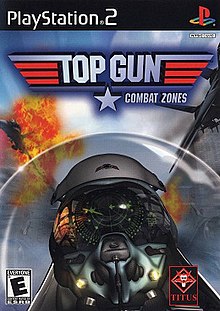 North American PlayStation ii cover art | |
| Developer(south) | Digital Integration (PS2/GameCube) Titus Interactive Studio (GBA) |
| Publisher(due south) | Titus Interactive (PS2/GameCube) Mastiff (GBA) |
| Series | Top Gun |
| Platform(due south) |
|
| Release | October 2001 (PS2) October 2002 (GameCube) April 2003 (Windows) December 1, 2004 (GBA) |
| Genre(s) | Combat flying simulation |
| Manner(s) | Single-thespian |
Peak Gun: Combat Zones is a combat flight simulation game named after the 1986 movie Pinnacle Gun. Information technology was developed past British studio Digital Integration[1] and published by Titus Interactive. It was originally released for the PlayStation ii in 2001, followed past a GameCube version in 2002. Versions were likewise released for the Game Boy Advance and Microsoft Windows. Top Gun: Combat Zones received "mixed or average reviews" according to Metacritic.
Gameplay [edit]
Top Gun: Combat Zones is a gainsay flying simulation game. The game includes the main "Game" mode and the "Quick Start" mode. Game way features 36 missions played beyond three eras, set up respectively in Vietnam, the Gulf States, and the Arctic Circle. Several grooming missions accept place at San Diego's Miramar base at the starting time of each era before the player moves on to alive gainsay. The player begins with an F-14 Tomcat fighter jet. Vii additional planes are unlocked every bit the game progresses: F-18 Hornet, F-22 Raptor, F-4 Phantom, JSF, YF-23, Osprey, and Harrier.[2] [three] [4] [v] [6] [7]
There are various mission objectives, such as destroying a target, providing air support for an evacuation, or escorting allies. Each mission includes a time limit. The player's weapons include bombs, a machine gun, and several types of missiles. A map informs the player of nearby enemies, although it does not specify their altitude. The role player tin view the game from within the cockpit, or can choose from several exterior perspectives. Points are awarded to the player for actions such as flying close to buildings or performing certain aerial moves. In Quick Kickoff, the player tin can create a customized mission with selectable settings such as the number of enemies and the playing location. The GameCube version includes "elementary" and "expert" controller settings.[2] [iii] [4] [5] [6] [7] The Game Boy Accelerate version features the same locations every bit the other versions.[viii]
Development and release [edit]
In Jan 1999, Titus Software announced that it had secured the rights to produce video games based on the 1986 film Top Gun.[ix] The game is named after the motion picture but is non directly related.[x] [11] Top Gun: Gainsay Zones was developed past Titus' Digital Integration, and was published by Titus in October 2001, for PlayStation 2 (PS2).[12]
In February 2002, Titus announced that it would release a GameCube version of Meridian Gun: Combat Zones.[thirteen] [14] The GameCube version featured improvements over the PS2 version, including enhanced resolution and depict altitude, and the add-on of new command options.[15] [16] The GameCube version was released subsequently in 2002.[17] [7] [18]
A Microsoft Windows version was released in Europe in April 2003.[12] In late 2004, Mastiff re-released the game on PS2 and GameCube through a deal with Titus.[19] [20] The Game Boy Accelerate version, adult by Titus, was likewise published by Mastiff in 2004.[8]
Reception [edit]
Top Gun: Combat Zones received "mixed or average reviews" co-ordinate to Metacritic.[21] [22] Reviewers noted that aside from the title, the game has no relation to the picture show.[23] [iii] [28] [6] [iv] [5] Fran Mirabella III of IGN plant the title misleading.[5] Barak Tutterrow of GameSpy'due south PlanetPS2 was surprised that Digital Integration did not take advantage of the "opportunity that the Top Gun name offers".[4] Doug Radcliffe of GameSpot was disappointed that the game did not make more use of the Height Gun license.[25] Shane Reed of Play stated that despite the lack of characters from the film, the "spirit of Top Gun certainly shines through," thanks to "slick replays and strategically placed" 1980s stone music.[27]
Reviewers criticized the game'south minimal storyline.[3] [6] [vii] [4] Steve Steinberg of GameSpy stated that the game contains "just the barest basic of a storyline".[6] Ralph Edwards of IGN stated that the pre- and post-mission screens "are rather boring, the presentation is very generic and at that place's not really a story that gives you a reason to fight."[2] Tutterrow wrote "you will almost likely wish for something interesting to reward you between missions, or at to the lowest degree provide some closure."[four]
GameZone's Louis Bedigian felt that Top Gun: Combat Zones and Star Wars: Starfighter were the best flying games bachelor for the PS2.[26] Other critics opined that Ace Gainsay 04: Shattered Skies was a superior game.[2] [4] [25] Tim Surette of GameZone wrote, "Entertaining at times, frustrating at others, Height Gun never actually picks gamers up and takes them away."[7] Edwards stated that the game "offers the base of what could be a very fun game, only just doesn't back it up with the fun role."[2] Computer and Video Games chosen it a "dull shoot 'em up" with "no real sense of speed to the craft y'all're piloting," and combat that is "long-winded, frustrating and fiddly."[24] Critics considered the controls easy to utilise,[28] [26] [half dozen] [2] but were critical of the in-game map for difficulty in locating enemies.[23] [2] [6] Radcliffe criticized the presence of a time limit.[25] GamePro stated that the missions tin go surprisingly dull and repetitive, and wrote, "There's often trivial tension, making the game feel less similar flying in combat and more similar running errands."[28] AllGame's Jon Thompson praised the game's variety, but stated that the planes largely handled the same as one another.[23]
Some critics praised the visuals, but felt that the game did not take full advantage of the PS2'due south graphical capabilities.[6] [26] [ii] Shawn Sanders of Game Revolution was critical of the graphics,[3] while Thompson considered them boilerplate.[23] Some criticized the explosions for their poor graphical quality.[three] [4] Radcliffe considered the plane explosions "particularly unimpressive," stating that they resemble "toy airplane models detonated by firecrackers."[25]
Sanders stated that the sound was probably the only decent attribute of the game.[three] Edwards praised the sound effects, but was critical of the "goofy lift music."[2] Tutterrow besides praised the audio effects, but described the music as "more than plumbing fixtures for taking a nap to then fighting for your life."[4] Radcliffe plant the use of rock music uninspired,[25] and GamePro was critical of the "subdued" sound effects and "cheesy" guitar riffs.[28] Thompson considered the music average and the audio effects generic.[23]
Some critics considered the GameCube version to exist an comeback over its PS2 counterpart.[18] [27] Lee Skittrell of Reckoner and Video Games praised the improved controls and higher resolution of the GameCube version, just even so found the graphics unremarkable. Skittrell likewise stated that the game was still defective a "real sense of speed," writing that "surely tearing through canyons in a fighter jet should be far more exciting than this?" Skittrell believed that Star Wars: Rogue Squadron Ii – Rogue Leader was a superior game.[xviii]
Surette praised the GameCube version for its graphics and elementary controls.[vii] Mirabella described the graphics, especially at low distance, as "blurry and outdated."[5] Steinberg had mixed feelings about the graphics of the GameCube version, stating that the game looked better while flight at high altitude. He besides felt that the "simple" and "expert" control settings were as well easy and too hard respectively. Steinberg enjoyed the sound effects of the GameCube version, only described the music every bit "generic techno junk".[half dozen] Mirabella criticized the mix of "cheesy" guitar ballads and "modernistic techno beats".[5] Surette considered the sound to be beneath boilerplate.[7]
References [edit]
- ^ "Digital Integration Ltd".
- ^ a b c d e f g h i j Edwards, Ralph (30 Oct 2001). "Top Gun: Gainsay Zones". IGN. Archived from the original on May 26, 2019.
- ^ a b c d due east f g h Sanders, Shawn (December 2001). "Top Gun: Combat Zones". Game Revolution. Archived from the original on 11 June 2004.
- ^ a b c d east f g h i j Tutterrow, Barak (27 November 2001). "Top Gun: Combat Zones". PlanetPS2.com. Archived from the original on 26 April 2005.
- ^ a b c d eastward f thousand Mirabella III, Fran (21 November 2002). "Top Gun: Gainsay Zones". IGN. Archived from the original on 14 May 2019.
- ^ a b c d e f g h i j Steinberg, Steve (25 Nov 2002). "Elevation Gun: Combat Zones (GCN)". GameSpy. Archived from the original on i April 2008.
- ^ a b c d eastward f chiliad h Surette, Tim (27 Nov 2002). "Top Gun: Combat Zones". GameZone. Archived from the original on 5 June 2009.
- ^ a b "Acme Gun: Combat Zones (GBA)". AllGame. Archived from the original on 14 November 2014. Retrieved xx January 2020.
- ^ Fudge, James (5 January 1999). "Titus Software secures Superlative Gun License". Reckoner Games Strategy Plus. Archived from the original on 23 May 2003.
- ^ MacDonald, Ryan (9 August 2001). "Summit Gun: Combat Zones Preview". GameSpot. Archived from the original on v February 2005.
- ^ Cooper, Michael (12 October 2001). "Top Gun: Gainsay Zones preview". Calculator and Video Games. Archived from the original on 17 July 2007.
- ^ a b Calvert, Justin (11 April 2003). "First expect: Top Gun: Gainsay Zones". GameSpot . Retrieved nineteen January 2020.
- ^ "Wing Into GameCube's Danger Zone". IGN. v Feb 2002. Retrieved 19 January 2020.
- ^ Varanini, Giancarlo (six February 2002). "Top Gun Combat Zones for the GameCube appear". GameSpot . Retrieved 19 Jan 2020.
- ^ Minkley, Johnny (xviii June 2002). "Titus gunning for the top". Reckoner and Video Games. Archived from the original on 9 January 2007.
- ^ Deci, T.J. "Summit Gun: Gainsay Zones overview". AllGame. Archived from the original on xiv November 2014. Retrieved 20 January 2020.
- ^ "Titus Reveals E3 Plans". IGN. 10 April 2002. Retrieved nineteen January 2020.
- ^ a b c d Skittrell, Lee (6 September 2002). "Top Gun". Reckoner and Video Games. Archived from the original on 3 January 2007.
- ^ Surette, Tim (12 November 2004). "Height Gun heading back into danger zone". GameSpot . Retrieved 19 January 2020.
- ^ Dunham, Jeremy (12 November 2004). "Top Gun Re-Released". IGN . Retrieved 19 January 2020.
- ^ a b "Tiptop Gun: Combat Zones (GameCube)". Metacritic . Retrieved 20 January 2020.
- ^ a b "Tiptop Gun: Gainsay Zones (PS2)". Metacritic . Retrieved xx January 2020.
- ^ a b c d eastward f Thompson, Jon. "Top Gun: Combat Zones review". AllGame. Archived from the original on 16 November 2014. Retrieved 20 January 2020.
- ^ a b "Acme Gun". Computer and Video Games. 19 December 2001. Archived from the original on xix January 2007.
- ^ a b c d e f Radcliffe, Doug (30 October 2001). "Top Gun: Combat Zones". GameSpot. Archived from the original on 5 February 2005.
- ^ a b c d Bedigian, Louis (29 November 2001). "Summit Gun: Combat Zones". GameZone. Archived from the original on 13 Jan 2020.
- ^ a b c Reed, Shane (November 2002). "Summit Gun: Gainsay Zones". Play. United States. p. 96.
- ^ a b c d "Height Gun: Combat Zones". GamePro. 11 November 2001. Archived from the original on xv March 2004.
External links [edit]
- Top Gun: Combat Zones at MobyGames
lowenthalalad1962.blogspot.com
Source: https://en.wikipedia.org/wiki/Top_Gun:_Combat_Zones
0 Response to "Top Gun Combat Zones Art for the Playstation 2"
Post a Comment